

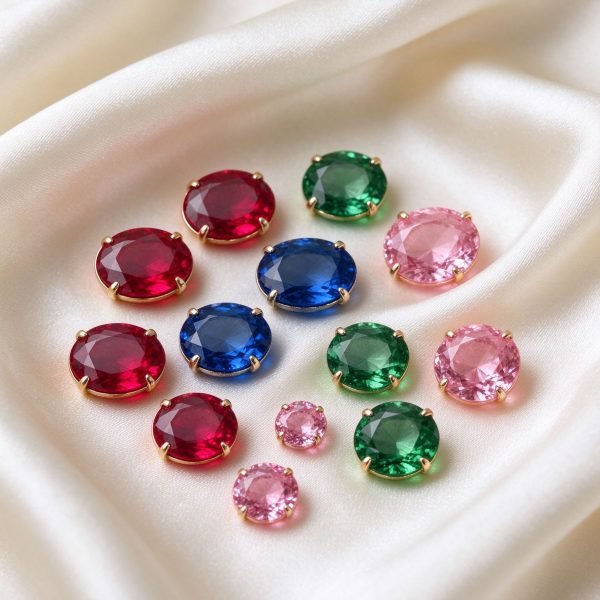
Two stones of identical carat weight can differ in price by 40 percent, and the shape is usually the reason. Cutting is where material gets spent, and that cost ends up in your quotation.
Yield, or why ovals cost less than rounds
A round brilliant wastes more rough than an oval, a cushion or a pear, because the cutter has to fit a round stone inside an irregular piece of rough. That is why round goods carry a premium in every material we handle, lab-grown included.
When we cut to order, the rough shape decides what is realistic. Ask for a 9×7 oval from a piece of rough that wants to be a cushion and you will pay for the waste, or get a smaller stone than you hoped.
Calibrated sizes vs free sizes
Calibrated means the stone is cut to a standard millimeter size so it drops into a cast setting: 3.0, 4.0, 5.0 mm rounds; 5×3, 6×4, 7×5, 8×6 ovals. The setting industry is built on these numbers, and they let you order stones without opening a mold.
Free sizes are cut for weight or for a custom design. They cost more per piece and require a bespoke setting, so unless the design demands it, stay calibrated.
Shape and the setting
The shape also decides how the piece is built:
- Round — bezels, four-prong, halos. Forgiving, hides small size drift.
- Oval — prong settings at the ends; the elongated shape flatters the finger and looks larger per carat.
- Cushion — corners need protection; a bezel or double-prong at each corner is safer.
- Emerald / step cut — flat table, open setting. Any inclusion or window shows immediately, so buy the cleaner grade.
- Pear, marquise — a prong at the point, or the tip will chip. These two shapes generate most of our repair conversations.
Matching pairs and parcels
For earrings the two stones must match in color, tone and face-up size, not just in millimeter dimensions. We match from a single parcel wherever possible, and we will say when a pair requires cutting a fresh stone. Expect a longer lead time for a matched pair than for two singles.
Larger orders are matched by tone bands. If you need twenty stones for a necklace, ask for the tone band up front and hold a sample approved by your design team before the rest are cut.
What we can and cannot promise
We can hold ±0.05 mm on calibrated sizes, match color within a stated band, and cut to a requested shape from rough we have on hand. We cannot guarantee an exact carat weight from a custom cut — the yield decides that, and we report actual weight before shipping.
Send the setting drawing or a photo with millimeter dimensions. That single image removes most of the back-and-forth on a cutting order.
Need a specific size, color or quantity? Send us the specification and we will check availability.