

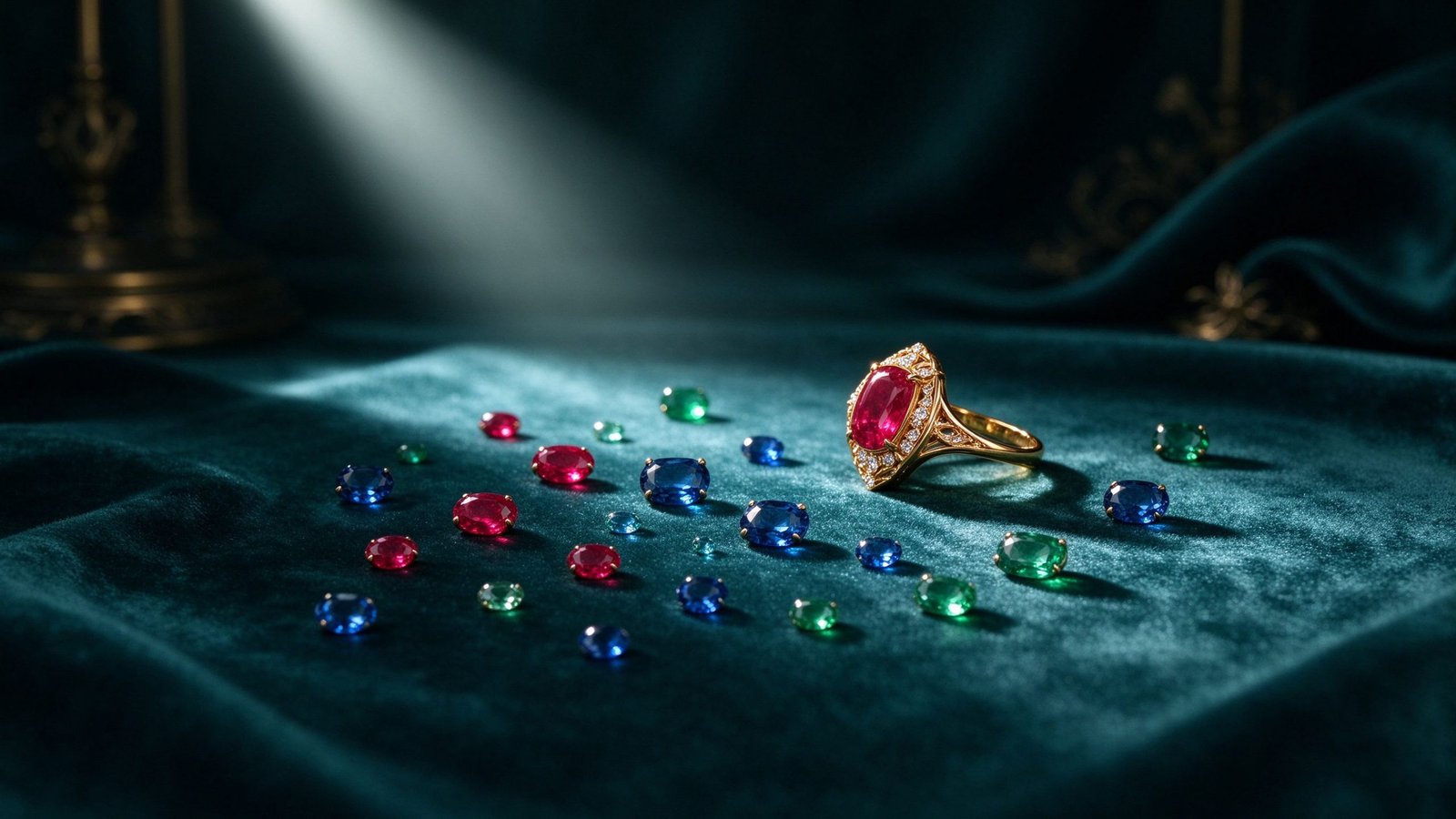
A buyer asked us last month why our lab-grown ruby costs a third of a natural ruby of the same size, and whether the difference shows on a finished ring. Fair question, and one we get every week. Here is how we answer it when we are standing at the cutting bench rather than writing a sales page.
The short version
Natural stones are mined. Lab-grown stones are crystallised in a furnace or reactor under controlled conditions. Chemically and optically they are the same material: a ruby is corundum either way. What changes is the supply, the inclusions, the paperwork and the price.
What actually changes in the parcel
With natural stones, every parcel is a mixed bag. Color drifts between stones, sizes are rarely exact, and matching a pair can take weeks. You buy what the mine produced and work around it.
With lab-grown, the growth run sets the parameters. If we commit to 7×5 mm oval in a pigeon-blood tone, the next run can hold that tone closely. Not perfectly — we still grade and sort — but close enough that repeat orders for a jewelry line stay consistent. That consistency is the real reason brands move to lab-grown for production, more than the price.
Price, honestly
Comparing per-carat prices is misleading unless you compare like for like. A natural ruby with the saturation and clarity of a good lab-grown stone can cost five to twenty times more. At the commercial end of the market, our lab-grown colored stones sit in ranges where a production budget works: dollars per piece rather than thousands.
That gap is not going away. Growth capacity keeps expanding and natural supply does not.
What buyers ask next
Can customers tell?
A trained eye with a loupe can usually spot growth patterns: curved striae in flame-fusion material, flux inclusions in flux-grown stones, and natural silk or fingerprints in mined stones. Untrained eyes cannot. This is why disclosure matters more than detection — most markets require it, and getting caught mislabelling is far more expensive than the price difference.
Do you provide certificates?
For lab-grown diamonds, yes, on request, from independent labs. For colored stones and CZ, a report is optional and priced per stone. For most production orders a signed specification sheet and our grading notes are enough. If your customer needs a certificate, tell us before production, not after.
Will the color hold over time?
Lab-grown corundum is stable. CZ is stable. Some treatments on natural stones are not, and that is where color change complaints usually come from — not from lab material.
Where natural still wins
If your customer is buying the story of a mined stone, no lab product replaces that. High-jewelry houses still build collections around natural stones and a provenance file. We supply both, and we will tell you which one fits the price point you are selling at.
How we handle a switch
Most brands that move from natural to lab-grown do it category by category, not all at once: earrings first, then pendants, then rings. Start with a small trial order, run your own setting test, and compare the finished piece against what you sold last season. If the visual match holds at retail distance, you have your answer.
Send us the specification you are working from — shape, size, color reference, quantity — and we will quote both routes so you can see the difference in your own numbers.
Need a specific size, color or quantity? Send us the specification and we will check availability.