

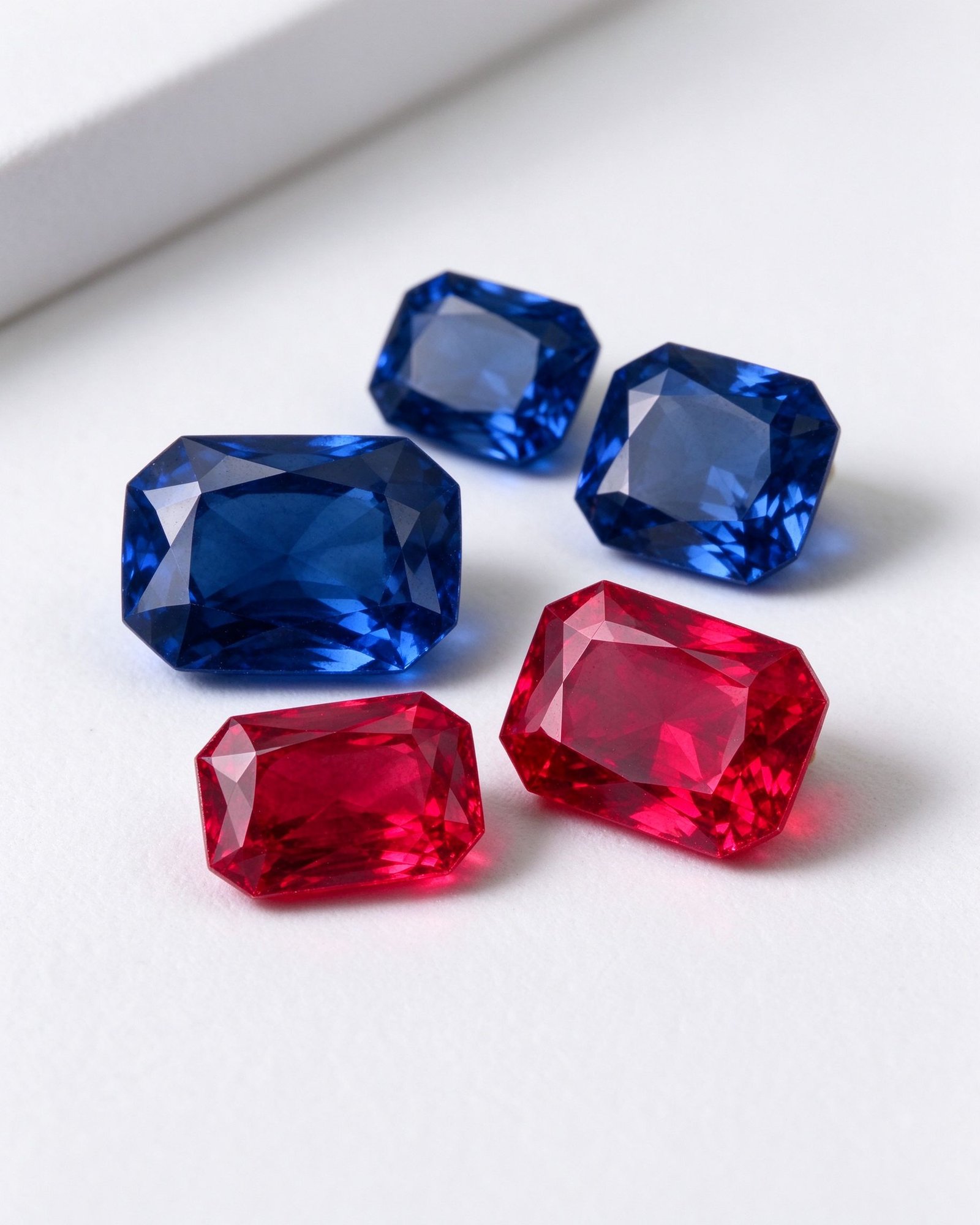
Two stones can both be described as “lab-created ruby” and still be completely different products: one costs thirty cents, the other thirty dollars. The difference is the growth method, and it decides color quality, clarity and what you can charge for the finished piece.
Flame fusion (the workhorse)
Flame-fusion corundum is made by dropping powdered alumina through a flame onto a boule. It is fast and cheap, and it produces the calibrated material most volume jewelry runs are built on. You get reliable sizes and a usable color range at a price that supports $20 retail earrings.
The trade-offs are visible under magnification: curved growth striae, occasional gas bubbles, and a color that can look a little flat next to a better stone. Heated too hard, some flame-fusion colors fade. Good suppliers test before shipping.
Flux and Czochralski growth
Flux-grown ruby and sapphire crystallise slowly in a melt, closer to how natural corundum forms. The result looks more like mined material: better saturation, more life in the stone, and inclusions that read as natural rather than synthetic under a loupe. Czochralski pulling gives similar quality with different internal structure.
These stones cost more per carat, but they are the right choice when the finished piece sells on look rather than on price. A halo ring in 18K with a washed-out center stone is a bad trade no matter how cheap the stone was.
Choosing between them
We ask three questions before quoting:
- What is the retail price of the finished piece? Under $150, flame-fusion usually makes sense. Above it, buyers start noticing the stone.
- How close is the stone to the eye? Stud earrings and pendants get close inspection; pavé melee does not.
- Does the design repeat? For a long production run, pay for the better growth method once and keep the color consistent across batches.
Sizes and calibration
Both methods are cut to standard calibrated sizes: 3 mm, 4 mm, 5 mm rounds, 5×3, 6×4, 7×5 ovals, and the usual square and cushion formats. If your setting is already cast, tell us the exact millimeter tolerance you can accept. We work to ±0.05 mm on calibrated goods and will say plainly when a size cannot be held.
What to write on the invoice
Be specific. “Lab-created ruby, flux grown” and “synthetic ruby, flame fusion” are different products and should be different line items. When a customer later asks what they bought, the invoice is the document that answers it.
If you are unsure which grade fits a design, send a photo of the setting and the target retail price. We will tell you where the money is best spent.
Need a specific size, color or quantity? Send us the specification and we will check availability.